
 Tweet
Tweet
Hey guys, it's been quite awhile since I've actually posted but I feel I should help speak up and speak out about this awareness that is being spread and brought up on Williams' passing.
To start off, if you are not aware, Robin Williams died August 11, 2014 in his home in California. The story is a bit long, but his agent/publicist found him after not answering the door. When the police arrived to examine and determine cause of death, they determined it was asphyxiation, or in non-medical talk, suffocation. According to those police reports, they found a belt nearby including multiple wounds on his arms and a pocket knife nearby as well. After the initial release of his alleged suicide, the aforementioned colleague of Williams claims that he had been suffering through severe depression. His wife recently came out and said he was also diagnosed with early stages of Parkinson's Disease which is a disorder of the brain that leads to shaking (tremors) and difficulty with walking, movement, and coordination. [cited from the U.S. National Library of Medicine]
But I want to bring up depression. Many people and comments I've seen/heard since Williams' passing is "How could such a great and funny guy take his own life?" I want to make it clear now, suicide is the easier of the two options when dealing with depression. For any of you who may not be familiar with depression, it's a very simple, yet infinitely complex state of mind. Often times, it stems from the lack of self-esteem (in personal experiences, at least) and the desire to be totally and unconditionally accepted. But there's also another catch to this, while you can hear your friends, family, and other loved ones tell and show you how much they love and care about you, the root problem remains, you need to accept yourself.
In my previous experiences, which some of you may recall, I had always hit my lows hard. At one point in my tenure of administrating Age of War I was willing to take my own life. I had began to work on the site's succession and new leadership models, preparing the emails of my passwords for the server, my account, my emails, etc. to help the site live on without me. I don't exactly remember how I got over it, but I think the root started with my best friend, Trevor's, passing back in October 2012. For many of you who are unfamiliar: When someone close to you takes their own life, you're placed into one of two outlooks, take your own life or hate the person you loved. For me, I was leaning on the former because I couldn't bring myself to the point of hating someone I loved so much. Do not get me wrong, I was angry at him. I had such a narrow mind that he was selfish and cowardly for taking his own life, unaware of how much pain and suffering he felt inside. Right before the main depression hit, my mother called me to check up on me. She knew what I was feeling, what I was thinking. She had been in my position at that age several times and she knew that my emotional imbalance would surely tip me off to the wrong side of me. Of course, I lied to her, telling her I didn't feel as bad as she knew I was, my attempt to hide all that pain.
When the main depression hit, I remember emphasizing on every negative thing about me: my real life social inadequacy, my lack of companionship, my terrible part-time job, the fact I had no driver's license and didn't want one, my dead best friend, the fact I was bumming and mooching off of people I claimed to "care" for, the presumable undermining of authority on my own website and disregard for my opinions. The list continues and it gets more personal with each additional listing. I had sunk so low and thought so little of myself, I was willing to do what some old classmates told me to, kill myself. Suicide can be contagious, and if it goes unchecked, it can become an epidemic. Again, I don't remember what eventually brightened my outlook. Maybe it was disconnecting from Age of War and many of you here, perhaps it was my return to Michigan, or maybe it was simply time itself. Whatever it was, I slowly became happier and bright again.
From that point on, I had a clear understanding of how hard and how significant real depression can be. I want to make this clear: DEPRESSION CAN HAPPEN TO ANYONE AND THE SEVERITY CAN BE EXTREME. But I want to go ahead and answer that question I mentioned previously about how someone so wonderfully loved by millions, who inspired and cheered just as many, why someone like that would even consider taking their own life.
In the example of comedians and other famous people who've taken their own life, such as Robin Williams, Lee Thompson Young, Ernest Hemingway, Kurt Cobain, Marilyn Monroe, Freddie Prinze Sr., the list continues. So why would someone like that take their own life. In the case of comedians, many times they've put up a barrier around themselves to hide their real selves behind it. As they continue to practice their jokes, they derive their source material off of what people in their childhood didn't like about them such as them being weird, fat, creepy, smelly, simply obnoxious, or whatever else you may have been bullied for, they likely were too. As they grow and build their material off of themselves, they put up this 'dummy' or facade that picks on themselves and others about what, a lot of times, people are too scared to say. This happens to invoke a positive reaction. It doesn't include love or caring, but a positive reaction and that's what feeds the lives of comedians, the happiness and acceptance from others. Many times, they feel that if people accept the front, the fake, that they like you and you can live in peace and happiness yourself. If they don't like that fake, well, that's okay, since it wasn't the real them.
Recalling what I said about self-acceptance and reflect that on these stars. I will use Chris Farley as an independent example pf depression and how it can start with anyone since his final days were accounted for with some detail. Chris Farley was a comedian and regular actor for Saturday Night Live in the 1990s. Much of his jokes were about fat people, often times picking on himself for being overweight. In his final days, he hired a hooker to simply hang out with him. During that final day, Farley and the hooker get into an argument about payment where Farley asks her not to leave him. As she is about to leave, Farley collapses on the floor and has trouble breathing. The hooker stole his watch and took some pictures of Farley's (now) dead body and left, where he faintly asked her not to leave him before he finally died and she left.
So maybe now there's a good understanding about how depression can affect individual, not so famous people, and how it can impact people who make a tremendous impact on others, but all the previous examples, aside from me, are dead now. While Farley wasn't a suicide, he was depressed. So what should you do about it? Well whenever you see someone starting to display those depression red flags:
Changes in activity levels - This includes fatigue, disconnection from interests, insomnia, and social seclusion
Physical changes - Increases or decreases in appetite, increases and decreases in weight, unexplained aches and pains
Emotional Pain - Prolonged sadness, unexplained/uncontrollable crying, feelings of guilt and worthlessness, despair, helplessness and hopelessness
Difficult moods - Irritability, anger, worry/anxiety, pessimism, self-critical, indifference
Changes in Thought Patterns - Inability to concentrate, indecision, memory problems, disorganization
Preoccupations with Death - Thoughts of death, suicidal ideation, feeling dead or detached
Please keep in mind red flags are not limited to this list and that symptoms may vary. If you suspect someone of depression, be there for them. While being there and reinforcing their self-esteem may not do much good, it shows a good thing. Another thing you should do is accept them and let them know. Point out the common faults in a polite, or even jokingly, way. "Yeah, so you pick your nose? Who cares? The 'popular' kids don't know how liberating it feels for the nostrils." If you still feel like they're going to be depressed, or if you are battling depression, I encourage them or you to make a call to the National Suicide Hotline. You don't need to stage an intervention, but you need to show the person you care for them and that you accept them for their faults.
Whether you take the time to read this or not, I want this to be the only real thing everyone takes out of this post:
Love and accept everyone for who they are. Do not be afraid to tell them and prove it. Anyone can be a victim of depression. As far as you know, accepting someone is enough to convince them to change their life decisions. And keep in mind, suicide is a permanent solution to a temporary problem.
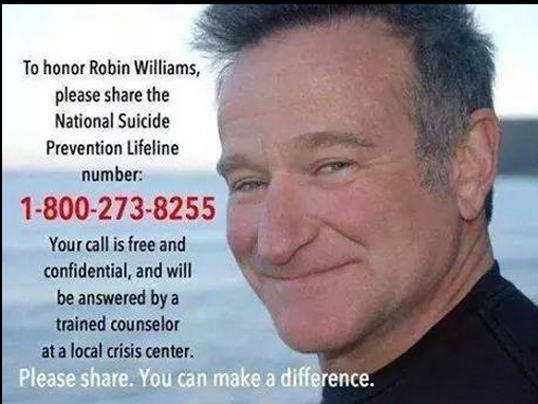
To start off, if you are not aware, Robin Williams died August 11, 2014 in his home in California. The story is a bit long, but his agent/publicist found him after not answering the door. When the police arrived to examine and determine cause of death, they determined it was asphyxiation, or in non-medical talk, suffocation. According to those police reports, they found a belt nearby including multiple wounds on his arms and a pocket knife nearby as well. After the initial release of his alleged suicide, the aforementioned colleague of Williams claims that he had been suffering through severe depression. His wife recently came out and said he was also diagnosed with early stages of Parkinson's Disease which is a disorder of the brain that leads to shaking (tremors) and difficulty with walking, movement, and coordination. [cited from the U.S. National Library of Medicine]
But I want to bring up depression. Many people and comments I've seen/heard since Williams' passing is "How could such a great and funny guy take his own life?" I want to make it clear now, suicide is the easier of the two options when dealing with depression. For any of you who may not be familiar with depression, it's a very simple, yet infinitely complex state of mind. Often times, it stems from the lack of self-esteem (in personal experiences, at least) and the desire to be totally and unconditionally accepted. But there's also another catch to this, while you can hear your friends, family, and other loved ones tell and show you how much they love and care about you, the root problem remains, you need to accept yourself.
In my previous experiences, which some of you may recall, I had always hit my lows hard. At one point in my tenure of administrating Age of War I was willing to take my own life. I had began to work on the site's succession and new leadership models, preparing the emails of my passwords for the server, my account, my emails, etc. to help the site live on without me. I don't exactly remember how I got over it, but I think the root started with my best friend, Trevor's, passing back in October 2012. For many of you who are unfamiliar: When someone close to you takes their own life, you're placed into one of two outlooks, take your own life or hate the person you loved. For me, I was leaning on the former because I couldn't bring myself to the point of hating someone I loved so much. Do not get me wrong, I was angry at him. I had such a narrow mind that he was selfish and cowardly for taking his own life, unaware of how much pain and suffering he felt inside. Right before the main depression hit, my mother called me to check up on me. She knew what I was feeling, what I was thinking. She had been in my position at that age several times and she knew that my emotional imbalance would surely tip me off to the wrong side of me. Of course, I lied to her, telling her I didn't feel as bad as she knew I was, my attempt to hide all that pain.
When the main depression hit, I remember emphasizing on every negative thing about me: my real life social inadequacy, my lack of companionship, my terrible part-time job, the fact I had no driver's license and didn't want one, my dead best friend, the fact I was bumming and mooching off of people I claimed to "care" for, the presumable undermining of authority on my own website and disregard for my opinions. The list continues and it gets more personal with each additional listing. I had sunk so low and thought so little of myself, I was willing to do what some old classmates told me to, kill myself. Suicide can be contagious, and if it goes unchecked, it can become an epidemic. Again, I don't remember what eventually brightened my outlook. Maybe it was disconnecting from Age of War and many of you here, perhaps it was my return to Michigan, or maybe it was simply time itself. Whatever it was, I slowly became happier and bright again.
From that point on, I had a clear understanding of how hard and how significant real depression can be. I want to make this clear: DEPRESSION CAN HAPPEN TO ANYONE AND THE SEVERITY CAN BE EXTREME. But I want to go ahead and answer that question I mentioned previously about how someone so wonderfully loved by millions, who inspired and cheered just as many, why someone like that would even consider taking their own life.
In the example of comedians and other famous people who've taken their own life, such as Robin Williams, Lee Thompson Young, Ernest Hemingway, Kurt Cobain, Marilyn Monroe, Freddie Prinze Sr., the list continues. So why would someone like that take their own life. In the case of comedians, many times they've put up a barrier around themselves to hide their real selves behind it. As they continue to practice their jokes, they derive their source material off of what people in their childhood didn't like about them such as them being weird, fat, creepy, smelly, simply obnoxious, or whatever else you may have been bullied for, they likely were too. As they grow and build their material off of themselves, they put up this 'dummy' or facade that picks on themselves and others about what, a lot of times, people are too scared to say. This happens to invoke a positive reaction. It doesn't include love or caring, but a positive reaction and that's what feeds the lives of comedians, the happiness and acceptance from others. Many times, they feel that if people accept the front, the fake, that they like you and you can live in peace and happiness yourself. If they don't like that fake, well, that's okay, since it wasn't the real them.
Recalling what I said about self-acceptance and reflect that on these stars. I will use Chris Farley as an independent example pf depression and how it can start with anyone since his final days were accounted for with some detail. Chris Farley was a comedian and regular actor for Saturday Night Live in the 1990s. Much of his jokes were about fat people, often times picking on himself for being overweight. In his final days, he hired a hooker to simply hang out with him. During that final day, Farley and the hooker get into an argument about payment where Farley asks her not to leave him. As she is about to leave, Farley collapses on the floor and has trouble breathing. The hooker stole his watch and took some pictures of Farley's (now) dead body and left, where he faintly asked her not to leave him before he finally died and she left.
So maybe now there's a good understanding about how depression can affect individual, not so famous people, and how it can impact people who make a tremendous impact on others, but all the previous examples, aside from me, are dead now. While Farley wasn't a suicide, he was depressed. So what should you do about it? Well whenever you see someone starting to display those depression red flags:
Changes in activity levels - This includes fatigue, disconnection from interests, insomnia, and social seclusion
Physical changes - Increases or decreases in appetite, increases and decreases in weight, unexplained aches and pains
Emotional Pain - Prolonged sadness, unexplained/uncontrollable crying, feelings of guilt and worthlessness, despair, helplessness and hopelessness
Difficult moods - Irritability, anger, worry/anxiety, pessimism, self-critical, indifference
Changes in Thought Patterns - Inability to concentrate, indecision, memory problems, disorganization
Preoccupations with Death - Thoughts of death, suicidal ideation, feeling dead or detached
Please keep in mind red flags are not limited to this list and that symptoms may vary. If you suspect someone of depression, be there for them. While being there and reinforcing their self-esteem may not do much good, it shows a good thing. Another thing you should do is accept them and let them know. Point out the common faults in a polite, or even jokingly, way. "Yeah, so you pick your nose? Who cares? The 'popular' kids don't know how liberating it feels for the nostrils." If you still feel like they're going to be depressed, or if you are battling depression, I encourage them or you to make a call to the National Suicide Hotline. You don't need to stage an intervention, but you need to show the person you care for them and that you accept them for their faults.
Whether you take the time to read this or not, I want this to be the only real thing everyone takes out of this post:
Love and accept everyone for who they are. Do not be afraid to tell them and prove it. Anyone can be a victim of depression. As far as you know, accepting someone is enough to convince them to change their life decisions. And keep in mind, suicide is a permanent solution to a temporary problem.


Comment